
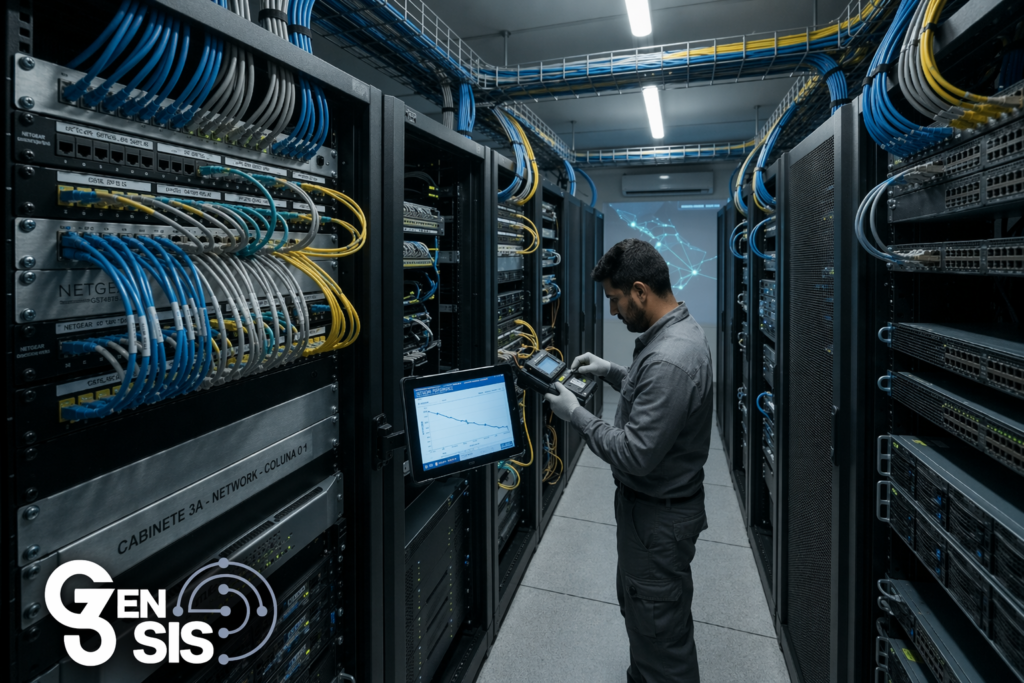
There’s something that happens in many medium-sized and large companies: people talk about innovation, artificial intelligence, automation, growth, expansion, and competitiveness. They set lofty goals, define ambitious strategies, and invest in new tools. But they rarely take a step back to examine what matters most: the foundation that underpins it all.
And that foundation is the infrastructure.
Because no matter how visionary a company is, how powerful its business strategy is, or how modern its digital ecosystem is, if the network doesn’t respond, if connectivity fails, or if the infrastructure can’t scale, then the entire business begins to suffer. At first, slowly. Then, more noticeably.
Technology infrastructure remains one of the least visible—yet most critical—assets within any organization. It rarely takes center stage in meetings. It doesn’t always make the headlines. It doesn’t generate as much buzz as other trends. But it quietly determines the speed of operations, the customer experience, team productivity, and a company’s true ability to grow.
Latin America is making this clear. The region now has over 450 million unique mobile subscribers, while mobile technologies and services account for more than 8% of regional GDP, with an economic impact of nearly $550 billion. In addition, 5G deployment is already underway across more than 30 operators and 13 countries, demonstrating that the business ecosystem is entering a new era of connectivity, speed, and demand. But this same progress also increases companies’ responsibility: digital growth no longer depends solely on adopting new tools, but on having an infrastructure capable of supporting them.
And here we see a reality that cannot be ignored. In Latin America and the Caribbean, only 67.3% of households had internet access in 2022, well below the 91.1% recorded in OECD countries. The gap is also evident across regions and income levels: in rural areas, access barely reached 35.8%, while in urban areas it stood at 74.8%. In lower-income households, connectivity remains far from being a stable and sufficient reality.
And yet, there are still organizations that view infrastructure as a technical matter, as an operating cost, as something that simply “has to work.” But today, that’s no longer enough.
Because infrastructure no longer just connects devices. It connects decisions.
It no longer just supports systems. It supports reputation.
It no longer just enables operations. It enables competition.
Every seamless video call, every platform that responds in seconds, every operation that stays up and running, every piece of data that travels securely, and every customer who enjoys a smooth experience has one thing in common: behind the scenes, there’s an infrastructure that’s doing its job well.
That is also why fiber optics continues to gain ground as one of the key indicators of change. Latin America and the Caribbean ended 2023 with 67 million FTTH subscribers—equivalent to 37% of households—and coverage that already reaches 67% of homes. The region is making progress, yes. But progress alone is not enough. The real difference will be made by companies that understand that infrastructure is not the bare minimum for business, but rather the driving force that can take it further.
In an environment where standing still costs money, time, trust, and opportunities, companies need more than just technology. They need a foundation that can withstand challenges, scale, protect, and support their evolution.
The best infrastructure isn’t the one everyone talks about.
It’s the one that keeps everything running smoothly.
It’s the one that lets you grow without fear.
It’s the one that turns complexity into confidence.
NetG360: the intelligent infrastructure that turns operations into trust, connectivity into growth, and technology into the driving force that propels businesses to go further.
Sources
- GSMA Intelligence, The Mobile Economy Latin America 2025.
- PNUD, Missed Connections: An incomplete digital revolution in Latin America and the Caribbean (2024).
- Fiber Broadband Association, Panorama FTTH LATAM 2024 – Summary.
- Banco Interamericano de Desarrollo (BID), informe sobre conectividad rural en América Latina y el Caribe.
Milena Rodriguez
Communications Department, Gen3sis